
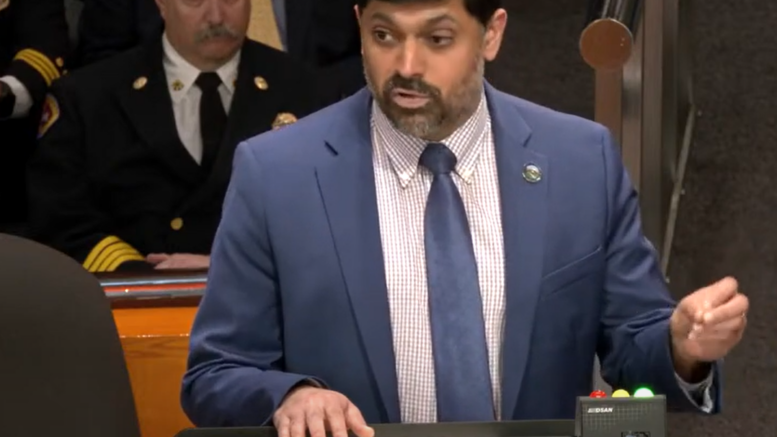
In a highly charged and contentious meeting on Wednesday, the Santa Clara County Local Agency Formation Commission (LAFCO) – a state-mandated commission responsible for determining boundary changes – voted 6-1 to dissolve the South Santa Clara County Fire District, effectively terminating the County’s decades-long fire service contract with CAL FIRE and transferring responsibility to the Santa Clara County Central Fire Protection District. Commissioner Mark Turner, who is also the Mayor of Morgan Hill, cast the lone no vote.
As a result, residents who live in the incorporated cities located in the Central District – which includes cities that were absorbed from CAL FIRE – could possibly see potentially slower emergency response times since it will cost $4.5 million more to maintain the same level of service as CAL FIRE under Central Fire.
When asked whether taxes would increase under the new arrangement, County Executive James Williams stated, “There is no change in anyone’s property tax bill either for those residents living in South County or for those residents currently living in the Central Fire Protection District. Not only is there no change in the proposal – there can’t be any increase in that ad valorum levee. It’s flatly prohibited by Proposition 13.”
Morgan Hill City Manager Christina Turner appeared to be unconvinced that cities would not be on the hook for the increased costs, saying, “While the County has indicated that these costs will be subsidized, there will be no concrete assurance that the financial burdens will not be placed on the City of Morgan Hill” in the cost-sharing agreements.
The decision sets in motion a high-stakes and complex transition that must be completed by July 1, 2025, when CAL FIRE’s current contract with the County officially ends. By that deadline, the County and Central Fire must finalize a host of unresolved issues: staffing, station handovers, equipment transfers, and crucially, financial agreements with affected cities like Morgan Hill and Gilroy. Without these issues resolved, large areas of South County could be left with unclear or inadequate fire protection coverage.
The decision has left local officials scrambling, particularly in Morgan Hill and Gilroy, which were not included in earlier consultations and now face uncertain coverage models.
“We only saw the revised funding tables a day and a half ago,” said City Manager Turner. “It’s not acceptable for cities to be handed new financial obligations at the 11th hour.”
Turner and others questioned why LAFCO would approve a sweeping jurisdictional change without locked-in financial terms, calling the process “premature” and “deeply flawed.”
“This feels like a predetermined outcome with little transparency,” said Gilroy City Administrator Jimmy Forbis. “Cities were not meaningfully brought into the planning process until it was too late.”
Commissioner Turner, who cast the only dissenting vote, said, “I’m very concerned about the lack of notification and consultation with the cities of Gilroy and Morgan Hill. Decisions like this should not be made without those most directly impacted being at the table.”
CAL FIRE officials forcefully rebuked the County’s transition plan, warning that it was built on unfounded assumptions and lacked any formal agreement for continued support or shared resources.
“We were never formally consulted about the handoff of service,” testified Jake Hess, CAL FIRE Santa Clara Unit Chief and Fire Chief of the South Santa Clara County Fire District. “Our department found out about the contract termination decision through secondhand channels.”
Tyler emphasized that CAL FIRE has not agreed to lend any engines, stations, or personnel to Central Fire post-transition, despite the County’s plan appearing to rely on such resources.
“We have not agreed to lend equipment, personnel, or stations to Central Fire. Any such understanding is entirely premature and unfounded,” Tyler said, calling the County’s assumptions a “house of cards.”
Without a formal agreement, Central Fire would face significant capital investments to replace CAL FIRE’s infrastructure.
Critics argued that the current arrangement with CAL FIRE should remain in place, saying that CAL FIRE is effectively and efficiently serving residents. CAL FIRE Local 2881 member Brandon Barrett summed up his opposition in a public comment saying, “When the stakes are this high, you don’t blow up what’s working. You protect it.”
“LAFCO has a duty to make decisions based on facts and public good, not assumptions,” he continued. “This plan is built on hope—not infrastructure.”
CAL FIRE emphasized its operational strengths and longstanding ties to the community, arguing that its integration with the state’s mutual aid system—along with its wildfire, disaster response, rural coverage capabilities, and institutional knowledge—offered unmatched service quality and coordination.
“We’ve been here for over 40 years. We know the terrain, the risks, and the people. We’re not just a state agency—we’re neighbors,” said Tyler.
With Central Fire now tasked with building out service capabilities in South County, and with CAL FIRE standing firm in its refusal to share assets without formal deals, the two parties face a potential stalemate in reaching an agreement fraught with logistical, legal, and operational challenges. The July 1 deadline looms large— getting it wrong could cost significant dollars and lives.
Despite the several concerns expressed, LAFCO voted to approve the dissolution of the South County Fire District and the annexation into Central Fire. The vote puts immense pressure on all parties to coordinate a seamless and fully staffed fire protection plan before the July 1 handoff date.
Now that LAFCO has approved the dissolution of the South Santa Clara County Fire District, the next step is a formal protest process. This involves notifying registered voters and landowners within the affected area, who will have the opportunity to submit written objections. If more than 25 percent of registered voters protest, a special election must be held. If 50 percent or more protest, the dissolution is automatically terminated.
The protest hearing is expected to take place later this spring and must occur before the July 1 deadline when CAL FIRE’s contract is set to expire and fire service responsibility officially transitions to the Santa Clara County Central Fire Protection District.
Editor’s Note: This story has been updated to remove quotes that were mistakenly attributed to the County Executive. The County Manager has stated that property taxes will not increase as a result of the new agreements.